



About network penetration testing
Attackers rarely compromise an organization through a single vulnerability.
Instead, they identify weaknesses across infrastructure, identities, devices, services, and trust relationships before combining them into practical attack paths that lead to sensitive systems and data.
Network Penetration Testing evaluates how resilient an organization's infrastructure is against these real-world attack techniques. By simulating adversary behavior, STACKTITAN identifies vulnerabilities, weak controls, excessive permissions, segmentation failures, and lateral movement opportunities that could allow attackers to expand access throughout an environment. The service is hardened by Cloudhawk™, a powerful platform offer to identify, understand, and manage cloud attack surfaces.

Why perform network penetration testing?
Traditional vulnerability scans can identify known issues, but they rarely demonstrate how attackers actually compromise environments.
Network Penetration Testing helps organizations understand how weaknesses connect, how trust relationships can be abused, and how attackers could move through the environment once access is obtained.
Organizations use Network Penetration Testing to:
- Identify exploitable infrastructure vulnerabilities
- Validate segmentation and security controls
- Assess identity and privilege risks
- Understand attacker movement paths
- Protect critical systems and sensitive data
- Strengthen resilience against real-world threats
By evaluating the environment from an attacker's perspective, organizations gain practical insight into their true security posture.
STACKTITAN network penetration services
Network security requires more than vulnerability discovery. These services evaluate infrastructure, identities, trust relationships, and attacker movement to reveal how isolated weaknesses could become enterprise-wide compromise.

Vulnerability assessment
Identify known vulnerabilities across servers, network devices, operating systems, and exposed services.

Network penetration
Go beyond vulnerability discovery to understand how attackers could exploit weaknesses within your environment.

Red teaming
Adversary emulation exercises test the effectiveness of people, processes, and technology against realistic attack scenarios designed to challenge detection and response capabilities.

Purple teaming
Improve collaboration between offensive and defensive teams.
STACKTITAN Purple Team engagements help organizations strengthen detection capabilities, refine response processes, and improve overall security operations effectiveness.

Adversarial simulation
Simulate specific attacker tactics, techniques, and procedures relevant to your industry, environment, or threat landscape.

Risk inheritance assessment
Third-party relationships, inherited infrastructure, acquisitions, and connected environments are assessed to identify external dependencies that may introduce hidden security exposure.
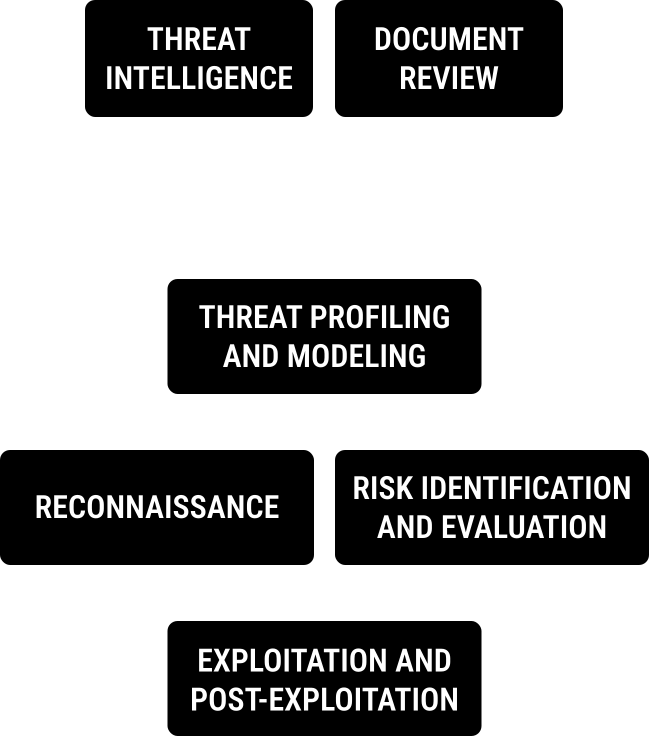
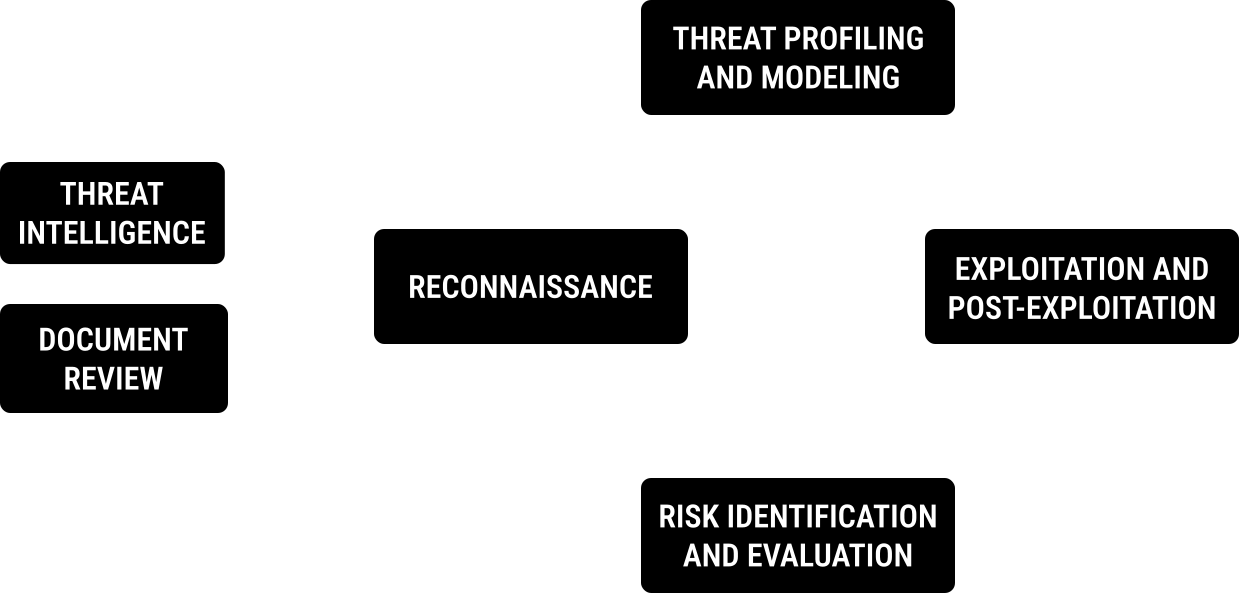

Understand how attackers approach your network vulnerabilities.
Industry frameworks and standards
STACKTITAN assessments are informed by recognized security frameworks and testing methodologies. Our approach combines these frameworks with proprietary research, expert analysis, and practical offensive security experience to deliver meaningful results.






Benefits of network penetration testing
Network Penetration Testing helps organizations identify exploitable weaknesses, validate security controls, and understand how attackers could move through interconnected systems. The result is improved visibility into real-world risk and greater confidence in the resilience of critical infrastructure.

Identify critical infrastructure weaknesses
Discover vulnerabilities affecting servers, network devices, operating systems, and exposed services before attackers can exploit them.

Validate segmentation controls
Assess whether network segmentation effectively limits attacker movement and protects critical assets.

Reduce identity-based risk
Identify excessive privileges, weak authentication controls, and opportunities for privilege escalation.

Understand attack paths
Reveal how individual network weaknesses can be combined into practical compromise scenarios.

Strengthen detection & response
Test how effectively security teams, monitoring tools, and response processes identify attacker activity.

Improve security investment prioritization
Focus remediation efforts on the weaknesses that create the greatest organizational risk.
Why choose STACKTITAN for network penetration testing?
Enterprise networks are built on trust, but attackers exploit misplaced trust to achieve compromise. STACKTITAN combines adversarial expertise, infrastructure security knowledge, and attack-path analysis to identify where weaknesses connect and how meaningful business risk can be reduced.

Real-world adversarial perspective
Real-world attacker methodologies reveal how vulnerabilities, identities, and trusted relationships can be combined to compromise enterprise environments.

Human-led, platform-assisted testing
Expert consultants leverage proprietary technologies, such as Cloudhawk™TM to improve visibility, coverage, analysis, and reporting quality.

Attack path-focused assessments
Infrastructure is evaluated as an interconnected environment, revealing how seemingly isolated weaknesses can become complete compromise scenarios

Actionable reporting
Technical findings are prioritized according to exploitability, operational impact, and remediation effort, enabling security teams to address the highest-value improvements first.

White-Glove delivery
Security, infrastructure, and leadership teams remain closely engaged throughout each assessment to ensure findings translate into practical security improvements.

Measurable security outcomes
Success is measured through validated risk reduction, stronger infrastructure resilience, and improved confidence in the effectiveness of security controls.
what our clients say
THE STACKTITAN DIFFERENCE
Deep expertise across interconnected technologies:
Our team understands applications, networks, identities, cloud platforms and infrastructure, allowing us to examine how risk moves across the wider environment.
Testing goes beyond tool-generated findings:
Automated results are validated and interpreted by specialists who can distinguish genuine exposure from false positives, isolated issues and technical noise.
Clients retain access to a trusted advisor:
STACKTITAN remains available to challenge assumptions, evaluate vendor claims and help clients determine whether newly reported risks are credible.
The “Stay Dangerous” culture keeps us current:
Continuous learning, tool development, research and industry participation help our team stay aligned with changing technologies and attacker behavior.
Additional services

Assess cloud platforms, identities, and supporting infrastructure connected to device ecosystems.



Move beyond point-in-time assessments with ongoing offensive security validation that evolves alongside your environment.
Identify vulnerabilities across customer portals, APIs, mobile applications, and management interfaces supporting connected products.
Case Studies

Helping a global manufacturer improve attack resilience through ongoing adversarial testing, OT assessments, and ransomware readiness exercises.


Helping a global manufacturer improve attack resilience through ongoing adversarial testing, OT assessments, and ransomware readiness exercises.

Helping a Fortune 50 retailer reduce application risk and improve vulnerability management across a large portfolio of internally developed applications.
Helping a Fortune 50 retailer reduce application risk and improve vulnerability management across a large portfolio of internally developed applications.

Evaluating customer-facing platforms and administrative systems to identify attack paths, strengthen controls, and improve overall service security.
Evaluating customer-facing platforms and administrative systems to identify attack paths, strengthen controls, and improve overall service security.

Assessing critical applications supporting research, intellectual property, and operational systems to reduce security exposure and improve resilience.
Assessing critical applications supporting research, intellectual property, and operational systems to reduce security exposure and improve resilience.

Helping a regulated financial organization identify application-layer vulnerabilities that could have exposed sensitive customer information while strengthening compliance.
Helping a regulated financial organization identify application-layer vulnerabilities that could have exposed sensitive customer information while strengthening compliance.
Helping a global manufacturer improve attack resilience through ongoing adversarial testing, OT assessments, and ransomware readiness exercises.
Helping a global manufacturer improve attack resilience through ongoing adversarial testing, OT assessments, and ransomware readiness exercises.
Helping a Fortune 50 retailer reduce application risk and improve vulnerability management across a large portfolio of internally developed applications.
Helping a Fortune 50 retailer reduce application risk and improve vulnerability management across a large portfolio of internally developed applications.
Evaluating customer-facing platforms and administrative systems to identify attack paths, strengthen controls, and improve overall service security.
Evaluating customer-facing platforms and administrative systems to identify attack paths, strengthen controls, and improve overall service security.
Assessing critical applications supporting research, intellectual property, and operational systems to reduce security exposure and improve resilience.
Assessing critical applications supporting research, intellectual property, and operational systems to reduce security exposure and improve resilience.
Helping a regulated financial organization identify application-layer vulnerabilities that could have exposed sensitive customer information while strengthening compliance.
Helping a regulated financial organization identify application-layer vulnerabilities that could have exposed sensitive customer information while strengthening compliance.
Helping a global manufacturer improve attack resilience through ongoing adversarial testing, OT assessments, and ransomware readiness exercises.
Helping a global manufacturer improve attack resilience through ongoing adversarial testing, OT assessments, and ransomware readiness exercises.
Helping a Fortune 50 retailer reduce application risk and improve vulnerability management across a large portfolio of internally developed applications.
Helping a Fortune 50 retailer reduce application risk and improve vulnerability management across a large portfolio of internally developed applications.
Evaluating customer-facing platforms and administrative systems to identify attack paths, strengthen controls, and improve overall service security.
Evaluating customer-facing platforms and administrative systems to identify attack paths, strengthen controls, and improve overall service security.
Assessing critical applications supporting research, intellectual property, and operational systems to reduce security exposure and improve resilience.
Assessing critical applications supporting research, intellectual property, and operational systems to reduce security exposure and improve resilience.
Helping a regulated financial organization identify application-layer vulnerabilities that could have exposed sensitive customer information while strengthening compliance.
Helping a regulated financial organization identify application-layer vulnerabilities that could have exposed sensitive customer information while strengthening compliance.
Helping a global manufacturer improve attack resilience through ongoing adversarial testing, OT assessments, and ransomware readiness exercises.
Helping a global manufacturer improve attack resilience through ongoing adversarial testing, OT assessments, and ransomware readiness exercises.
Helping a Fortune 50 retailer reduce application risk and improve vulnerability management across a large portfolio of internally developed applications.
Helping a Fortune 50 retailer reduce application risk and improve vulnerability management across a large portfolio of internally developed applications.
Evaluating customer-facing platforms and administrative systems to identify attack paths, strengthen controls, and improve overall service security.
Evaluating customer-facing platforms and administrative systems to identify attack paths, strengthen controls, and improve overall service security.
Assessing critical applications supporting research, intellectual property, and operational systems to reduce security exposure and improve resilience.
Assessing critical applications supporting research, intellectual property, and operational systems to reduce security exposure and improve resilience.
Helping a regulated financial organization identify application-layer vulnerabilities that could have exposed sensitive customer information while strengthening compliance.
Helping a regulated financial organization identify application-layer vulnerabilities that could have exposed sensitive customer information while strengthening compliance.
Frequently Asked QuestionS

Network Penetration Testing is a security assessment that evaluates internal and external infrastructure, services, devices, identities, and security controls for vulnerabilities that attackers could exploit.
Vulnerability scanning identifies potential weaknesses. Network Penetration Testing validates vulnerabilities, assesses exploitability, and demonstrates how attackers could leverage them in real-world scenarios.
External testing evaluates internet-facing assets and perimeter defenses. Internal testing assesses risks that could be exploited after an attacker gains access to the environment.
Most organizations should conduct Network Penetration Testing annually and following major infrastructure changes, acquisitions, cloud migrations, or significant technology deployments.

