
For banks, insurers, payment firms and fintechs, annual penetration testing has been a fixed line in the security budget for years now. NYDFS Part 500, the FTC Safeguards Rule and PCI DSS all require it, and DORA adds threat-led testing for groups operating in the EU. But choosing a penetration testing company for financial services is harder than it sounds. Cost matters, of course, but quality matters more. Quality here means one thing: finding the vulnerabilities a real attacker would exploit.
That market is crowded and complicated. Some firms sell red team services that try to move money the way a real attacker would. Others sell a dashboard and a scan-led test that ticks a SOC 2 box, but might do little to prove your real-world resilience. Both get called "penetration testing", and you'll often see them listed side by side.
This guide sorts them out, whether you need fintech penetration testing for a first SOC 2 audit or a red team for a regulated bank. Below are the 10 penetration testing companies we'd shortlist for a bank, credit union, insurer, payment firm, wealth manager or fintech in 2026. On this page, you'll understand what each one is best for, and how to tell a people-led firm from a platform before you sign.
Key takeaways
- A penetration testing company is an outside firm you hire to attack your systems, with permission, and find weaknesses before real attackers do. In financial services, that means checking whether someone could move money, reach customer data or approve transactions they shouldn't.
- Most U.S. financial institutions must test at least once a year under NYDFS Part 500, the FTC Safeguards Rule or PCI DSS. GLBA examiners, SOC 2 auditors and bank partners expect the evidence too.
- Providers fall into three groups: people-led firms built around expert testers, platform-led PTaaS providers that sell testing through a portal, and hybrids that offer both.
- Security-mature institutions usually need a people-led firm that can run red team and purple team engagements. An early-stage fintech that needs its first SOC 2 report may find a PTaaS platform is sufficient.
- Pricing is quote-based almost everywhere. So compare what each quote includes: hours of manual testing, who does the work, retesting, and a report your auditor will accept.
Top penetration testing companies for financial services and fintechs compared
If you're a regulated bank, fintech, or financial services organization that has already covered the compliance basics, these are the 10 firms we'd put on a shortlist.
Why penetration testing for financial institutions is different
All penetration tests look for vulnerabilities. But a financial services penetration test also has to ask whether someone can move money, see another customer's balance, or approve a claim or a transaction they shouldn't. Those flaws rarely show up in an automated scanner, because they live in authorization logic, in the order of API calls, and in the assumptions one system makes about another. That is difficult, and sometimes impossible, to get from a purely platform-led approach.
In STACKTITAN's bank and fintech engagements, most exploit chains build on the same three weaknesses:
- An unmapped external attack surface: Public-facing assets nobody is tracking expose API keys, credentials or hidden endpoints without strong controls. They're hard to find, but valuable to the attacker who does.
- Excessive permissions: Accounts with more access than the job needs, from read access to a sensitive file share to a privileged employee whose access sits in one account instead of separate accounts for different levels of trust.
- Sensitive actions without extra checks: Funds transfers that don't require re-authentication or dual approval turn an account takeover into real financial loss. At one bank, a subtle authentication downgrade flaw in the web portal let STACKTITAN take over several business users' accounts, each with full transfer rights.
Financial institutions have more people reading the report too. An examiner, an auditor, a card brand or a board risk committee all typically ask for the findings, meaning the evidence needs to stand up outside the security team. And production environments are fragile in ways that are unique to financial institutions. For example, a test that knocks over a payments queue at 9 a.m. on a Monday is a business-critical incident, not a finding.
Finally, the largest financial institutions are security-mature. They already scan, already patch, and already run a SOC. For them, the useful question is whether their people and controls would catch a capable attacker, and how far that attacker would get before anyone noticed and closed the gap. To answer that question, it takes a red team or purple team, and a different kind of provider. In one of our red team projects, our testers used social engineering to reach a bank's internal network, worked through teller accounts until they had access to the banking software and, with the bank's permission, completed a funds transfer.
People-led vs platform-led, or both?
This is the distinction most providers skip, and yet it should shape your shortlist more than any ranking.
That's not to say they are mutually exclusive either, because many of the names on our list now sit somewhere in between. NetSPI, Bishop Fox and Praetorian all run consulting teams alongside their own platforms. That combination can work well. Just make sure you ask which half of the business your engagement will actually come from.
Platforms can add useful coverage between annual tests, but the catch is volume. Crowdsourced programs can generate a stream of submissions and duplicates that someone on your team has to triage, and testers' growing use of AI has raised that volume without necessarily raising quality. It's a common reason financial institutions choose STACKTITAN over a platform. They want a direct relationship with the people testing their systems, and they don't have the capacity to review submissions all year.
Our view is that if you're a regulated institution with a mature security program, the platform should support the expert, not replace them. If you're an early-stage fintech that needs a clean test report for your first SOC 2 audit, a platform may be all you need for now.
How we chose these companies
We looked at providers that regularly serve banks, credit unions, insurers, payment firms and fintechs, and judged them on seven things:
- Depth of manual testing: how much of the work is done by experienced testers rather than automated scanners.
- Financial services attack knowledge: payments, money movement, authorization logic, open banking APIs and third-party integrations.
- Proven financial services track record: published case studies, named clients or recognized threat-led testing work with banks, insurers, payment firms or fintechs.
- Range beyond the penetration test: whether they can run red team, purple team or threat-led testing when you outgrow a standard test.
- Evidence regulators and auditors accept: report quality, retesting and mapping to frameworks like PCI DSS, NYDFS Part 500 and SOC 2.
- Customer reviews: what clients say on independent sites such as G2, Gartner Peer Insights and Clutch, especially about communication, report quality and retesting.
- Clarity of delivery model: whether you know who is testing and how.
The 10 best penetration testing companies for financial services and fintech
1. STACKTITAN
STACKTITAN is an expert-led offensive security firm built for organizations in highly regulated, complex industries, with financial services at the top of that list. STACKTITAN's founders, Chris Patten and Dan Kottmann (co-authors of Black Hat Go), are closely involved in client engagements, so the people who scope the work are the people who understand the attacks.
The founders are practitioners first. Their book, Black Hat Go (No Starch Press, 2020), is a hands-on guide to building offensive security tools. Chris is a U.S. Air Force veteran with more than 25 years in military intelligence, adversarial simulation and penetration testing, and the wider team includes U.S. Army veterans with backgrounds in military intelligence, digital forensics and technical exploitation.
Delivery model: People-led, with proprietary tooling
Best for: Security-mature banks, insurers and fintechs that want experts to test their defenses the way a real attacker would, then help fix what they find.
STACKTITAN's financial services strengths
- Proven at a large fintech bank under regulatory scrutiny, where a red team engagement grew into a multi-year program of recurring red team assessments, detection engineering and application testing across 10 business applications, cutting exposed risk by 50%, training 120 developers and improving mean time to detect.
- Red team and purple team engagements that show how far an attacker could get toward payment systems and customer data, and whether anyone would notice. In one, STACKTITAN took over a financial organization's badge provisioning system, issued itself a temporary access badge, reached the C-suite floor and remotely opened doors to the data center and network closet.
- Vendor technology assurance that helps institutions evidence third-party risk management to examiners.
Other strengths: Senior testers cover every engagement using STACKTITAN's Offensive x Defensive methodology, which pairs red team thinking with purple team collaboration so findings feed directly into detection and remediation. They're backed by the firm's own tooling: Cerebral, an assessment engine for orchestration, evidence management and continuous testing; Cloudhawk, for cloud exposure across AWS, Azure, Microsoft 365 and hybrid environments; and Canopy, a continuous exposure management service. Services run from application, API, cloud and source code testing to threat hunting, compromise assessments, attack path assessments and AI risk assessments.
Limitations: STACKTITAN doesn't sell a self-service platform. Every engagement is scoped and quoted, so it isn't designed for buyers who only need a quick, one-off compliance report.
Pricing: Quote-based, scoped to each engagement.
2. NetSPI (now including Synack)
NetSPI is one of the best-known names in bank penetration testing. It pairs more than 350 in-house security experts with its own PTaaS platform, which gives clients real-time findings, remediation tracking and program-level reporting. In October 2026 it completed a KKR-backed merger with Synack, adding the Synack Red Team, more than 1,500 vetted researchers who work as independent contractors, and Sara, an AI agent that finds and validates vulnerabilities. The combined company has more than $200 million in revenue.
Delivery model: Hybrid (consulting + PTaaS platform + crowdsourced researchers)
Best for: Large banks and insurers running a high volume of tests every year that want one provider and one platform to manage them.
NetSPI's financial services strengths
- Says it works with nine of the top 10 U.S. banks.
- Program-level reporting across many applications, which helps when examiners and auditors want evidence for the whole estate.
- Synack's packaged compliance penetration test (SynackST) and crowdsourced researchers add audit-driven and continuous testing options.
Other strengths: Scale, a mix of continuous and point-in-time testing, and attack surface management alongside penetration testing.
Limitations: The Synack integration is new. The companies say existing customer relationships and service models will continue, but ask how your testers and platform will change over the next year.
Pricing: Quote-based, with no public rate card.
3. Bishop Fox
Bishop Fox has a strong reputation for application security, red teaming and offensive research. Its Cosmos platform adds continuous testing of the external attack surface, with findings validated by people, on top of point-in-time engagements.
Delivery model: Hybrid (consulting + Cosmos platform)
Best for: Fintechs and financial firms that want consulting-grade testing plus ongoing coverage of what they expose externally.
Bishop Fox's financial services strengths
- Equifax is a named customer, using Cosmos for continuous security testing.
- Continuous external testing suits fintechs that ship quickly and expose a lot to the internet.
Other strengths: Deep application security and red team expertise, and continuous testing with human validation of findings.
Limitations: Pricing isn't published, and continuous Cosmos coverage is a separate service from point-in-time testing, so check what each quote includes.
Pricing: Quote-based, with no public rate card.
4. Mandiant (Google Cloud)
Mandiant, part of Google Cloud since 2022, is known first for incident response, and that experience shapes its red team work. Its consultants build scenarios around how real threat groups have attacked organizations.
Delivery model: People-led consulting
Best for: Large institutions that want red teaming grounded in threat intelligence.
Mandiant's financial services strengths
- Tracks financially motivated threat groups under its "FIN" designations, such as FIN7, so scenarios can mirror the groups that target banks and payment firms.
- Incident response experience at major institutions gives boards and regulators a credible picture of exposure.
Other strengths: Threat intelligence and incident response depth, global reach, and links into Google Cloud's security products.
Limitations: As part of a very large organization, its pricing and scheduling are geared to enterprise buyers.
Pricing: Quote-based, with no public pricing for consulting.
5. SpecterOps
SpecterOps created BloodHound, the widely used open-source tool for mapping attack paths through Active Directory and Entra ID. It runs adversary simulation, red team and penetration testing services, and sells BloodHound Enterprise, a platform for continuously managing identity attack paths.
Delivery model: People-led, with BloodHound tooling
Best for: Banks and insurers with complex Microsoft identity estates that want to understand and close attack paths to critical systems.
SpecterOps' financial services strengths
- Identity is often the shortest route from a phished laptop to a payments system, and that is SpecterOps' specialty.
- BloodHound Enterprise lets institutions keep closing those paths between tests.
Other strengths: Deep identity attack path expertise, well-regarded training, and tooling used across the security industry.
Limitations: Its specialty is identity and adversary simulation, so it's a less obvious choice for a high-volume application testing program.
Pricing: Services are quote-based. BloodHound Enterprise is listed on AWS Marketplace from $30.90 per employee, with a $77,250 minimum for 12 months.
6. NCC Group
NCC Group is one of the largest security consultancies in the world. Its CREST profile lists support for regulated threat-led testing schemes, including CBEST in the UK and TIBER in the EU, along with equivalent schemes in Asia-Pacific and the Middle East, and it's an NCSC-approved CHECK provider in the UK.
Delivery model: People-led global consultancy
Best for: Multinational banks and insurers that need one provider for threat-led testing across several jurisdictions, including DORA's TLPT in the EU.
NCC Group's financial services strengths
- Experience with regulator-led threat-led schemes such as CBEST and TIBER.
- One provider for the U.S., UK and EU entities of a multinational group.
Other strengths: Scale, and breadth across testing, incident response and consulting.
Limitations: As a very large global firm, it's worth confirming which regional team will deliver your work and who the named testers are.
Pricing: Quote-based, with no public pricing.
7. Coalfire

Coalfire is a PCI Qualified Security Assessor and FedRAMP 3PAO, so its testing sits naturally alongside formal compliance assessments. Its penetration testers cover applications, cloud, networks and Active Directory, plus secure code review.
Delivery model: People-led, compliance-focused
Best for: Payment firms and fintechs whose main driver is PCI DSS or federal compliance.
Coalfire's financial services strengths
- Testing and PCI DSS assessment evidence from the same provider, which suits payment processors and card issuers.
- Assessments across more than 85 frameworks, so testing can map to several regimes at once.
Other strengths: Compliance depth and a broad testing team.
Limitations: Its center of gravity is compliance, so institutions focused on adversary simulation may prefer a more specialized red team.
Pricing: Quote-based, with no public pricing.
8. Trail of Bits
Trail of Bits is a research-heavy firm known for security audits of smart contracts, blockchain protocols and cryptographic code. It also builds widely used open-source security tools.
Delivery model: People-led, research-focused
Best for: Crypto exchanges, digital asset custodians and fintechs building on blockchain.
Trail of Bits' financial services strengths
- Deep cryptography and blockchain audit experience for digital asset firms.
- Code-level review for products where the risk sits in the cryptography itself.
Other strengths: Research depth and open-source tooling.
Limitations: Less of a fit for a standard network or web app compliance test, and its rates reflect its specialist focus.
Pricing: Quote-based, with no public pricing.
9. Cobalt
Cobalt sells penetration testing through its platform, using a credit-based model. The testing itself is done by people: the Cobalt Core, a network of more than 500 vetted freelance penetration testers that the platform matches to each test, rather than an in-house consulting team. It also offers red teaming and secure code review.
Delivery model: Platform (PTaaS)
Best for: Early-stage fintechs that need frequent, well-defined app and API tests for SOC 2 or customer due diligence.
Cobalt's financial services strengths
- Fast starts (its Standard tier lists a three-business-day start) for fintechs facing an audit or bank partner deadline.
- Unlimited retesting during the contract term and Jira integrations, so development teams can close findings quickly.
Other strengths: Speed, predictable credit-based buying and developer-friendly integrations.
Limitations: Testing runs against a defined scope with freelance testers, so it's less suited to open-ended red teaming or deep, multi-step business logic attacks. Credits don't roll over to the next contract year.
Pricing: One credit equals eight hours of testing, sold in annual packages, but the price per credit isn't published.
10. Praetorian
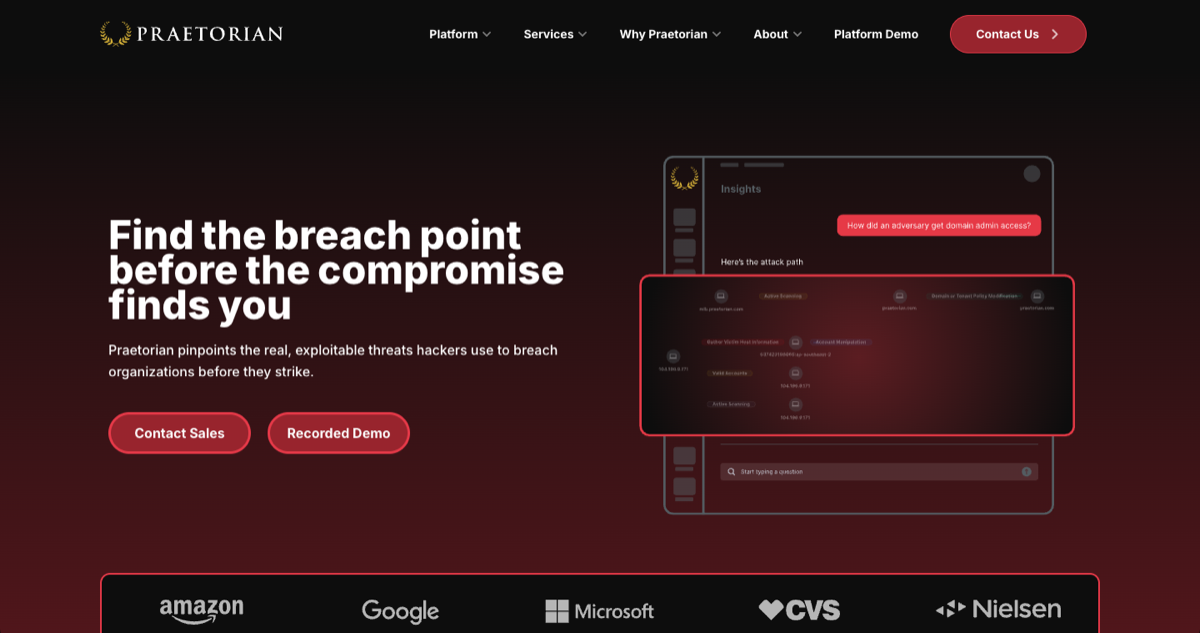
Praetorian pairs its own team of offensive security engineers with the Praetorian Guard platform, which brings together attack surface management, continuous penetration testing, attack path mapping and breach and attack simulation. It also runs red team and purple team engagements.
Delivery model: Hybrid (in-house engineers + Praetorian Guard platform)
Best for: Large enterprises that want one provider for continuous exposure management and expert-led testing.
Praetorian's financial services strengths
- Its red team service lists financial objectives such as moving funds to a nominated bank account, reaching executive mailboxes and stealing customer data.
- Says its platform helps clients meet frameworks including GLBA and NYDFS.
Other strengths: In-house engineers rather than a crowd, continuous testing between annual tests, and a track record of open-source security tools.
Limitations: Its public customer logos are mostly large technology and consumer brands, and it publishes no financial services case studies, so ask for relevant references.
Pricing: Quote-based, with no public pricing.
What the regulations actually require
Most penetration testing for financial institutions starts with a rule that says it must happen. The rules differ on frequency, scope and who they apply to, so it pays to know which ones you're actually under.
What does financial services penetration testing cost?
Almost every firm on this list, including STACKTITAN, prices work by quote rather than a published rate card. That's because the cost depends on scope, such as:
- the size of your organization, in employees, locations and systems
- the number of applications and APIs
- whether source code is included
- whether the test runs in production
- whether you need a red team rather than a penetration test
- whether the goal is a baseline or an objective-based test
- how much retesting and reporting your regulators expect.
Platform providers are the exception. Their credit and subscription models make it easier to compare like for like, but the price usually covers a narrower, predefined scope.
For a scoped engagement, size usually moves the price most. A credit union with 50 employees has a far smaller attack surface than a national firm with 10,000. As a guide, a small organization can expect to pay about $20,000 to $25,000 (2026) for a network penetration test, and a much larger one three to four times that. A red team typically costs about twice as much as a network penetration test, because the tradecraft, tooling and methodology are more advanced and fewer operators can deliver it.
The more useful comparison is what each quote includes. Ask each provider how many hours of manual testing are included, who will be doing it, whether retesting is part of the price, and whether the report will satisfy your auditor without a second round. Quotes are rarely like for like, because scope, methodology and rules of engagement vary. A quote at a quarter to half of the others usually means junior or offshore testers, a vulnerability scan sold as a penetration test, or a different scope.
Questions to ask a penetration testing company before you sign
- Who will actually do the testing, and what is their experience with banks, payments or fintech?
- How much of the engagement is manual testing, and how much is automated? If AI-driven automation is involved, how is it governed?
- Can you show an anonymized report from a financial services engagement?
- How do you test production systems safely, and what happens if something breaks?
- Is retesting included, and how quickly can you turn it around?
- How will your report map to the regulations and frameworks we answer to?
- If we outgrow a standard penetration test, can you run a red team or purple team engagement?
- Are you a people-led firm, a platform, or both, and which part of the business will our engagement come from?
If you only have time for two, make it the first two. Push for specifics on the real-world experience of the people who will test your systems, and on who is accountable for any AI-driven automation, what guardrails it runs under and who checks its output before it reaches your report.
Why financial institutions choose STACKTITAN
The firms on this list are all capable. The difference is what you're buying. STACKTITAN works best for organizations that have moved past "do we have a penetration test report?" and want to know whether their defenses hold up against a skilled, determined attacker.
That shows in how engagements develop. At the large fintech bank mentioned above, executives wanted an unbiased view of risk from an outside expert. STACKTITAN started with a red team exercise that tested technology, people and processes together. That work led to targeted penetration tests, recurring red team assessments, detection engineering exercises, web and mobile application assessments across 10 business applications, source code reviews, a vulnerability management program and four secure development workshops. The bank cut its exposed risk by 50%, trained 120 developers, improved its mean time to detect and now treats STACKTITAN as its go-to security advisor.
Three things make that possible.
- The founders stay involved, so senior testers work on the engagement as well as the sales call.
- STACKTITAN's own tools, Cerebral, Cloudhawk and Canopy, give testers visibility that off-the-shelf tools don't, while the judgment stays with people.
- STACKTITAN offers the advanced services financial institutions grow into, like red and purple teaming, threat hunting, compromise assessment, attack path assessment, vendor technology assurance and AI risk assessment.
If you're building next year's testing program, talk to STACKTITAN's team about where a red team or targeted application assessment would tell you the most.